Tag Archives: favorite posts

Superman II 2.19: Die Hard

I grant you that life was simpler back then. In 1981, we didn’t have smartphones or streaming television, and the only computer I’d ever been in the same room with was a Commodore PET that could only run programs recorded on a cassette tape.

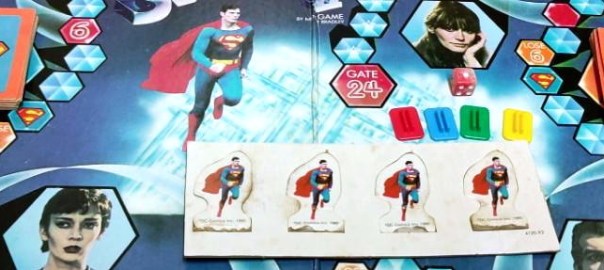
But even in simpler times, did we really need to be told in the instructions for a board game that you were supposed to “open up the gameboard and place it on a flat surface”?

Continue reading Superman II 2.19: Die Hard

Superman II 2.17: The Curriculum

Kryptonian Memory Bank:
Education Crystal # Three-Zero-Eight
Earth Culture (Section B)
Student Evaluation Form: Kal-El

Message begins:

As per Science Council guidelines, Kryptonian Memory Bank instructors are required to administer the following student evaluation form at the completion of this Education Crystal.

As a reminder, you will be evaluating the course that begins:

“Kryptonian Memory Bank, Education Crystal number Three-Zero-Eight. Earth Culture (Section B). Trees, by Joyce Kilmer of the planet Earth. I think that I shall never see a poem lovely as a tree…”

Your evaluation will be sent to the Kryptonian Board of Education Crystals and will help us to improve the Education Crystal remote learning experience. Thank you for your participation.

Continue reading Superman II 2.17: The Curriculum

Superman II 2.15: The Symposium

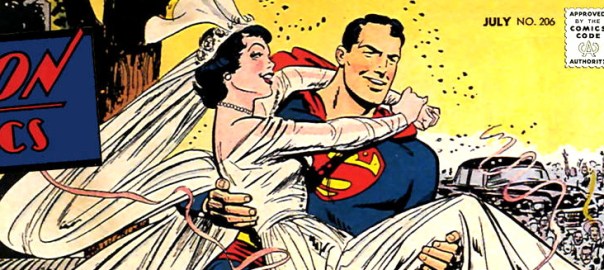
Okay, so we’ve currently got Clark Kent and Lois Lane locked up in a fuzzy pink honeymoon box, and we’re planning to keep them there until they make some progress on their relationship. It’s tough love, for sure, but they’ve spent more than forty years avoiding the obvious, and unless we do something about it, Lois is going to start throwing herself off of things again.

But this is a major turning point in the Superman/Lois relationship, and you can’t take that step lightly. In fact, in 1977 — a year before the first Superman movie was released — a panel of Superman writers, artists and editors were assembled to take part in a Super-Symposium.

It was such a big deal that they gave it four text pages in DC Special #5, asking the question: “SHOULD SUPERMAN MARRY LOIS LANE?”

Continue reading Superman II 2.15: The Symposium

Superman 1.98: Turn the World Around

Lois Lane is dead.

Now, you and I know that this is a comic book movie, and in superhero comics, almost nobody dies permanently. Superman died in 1992, Spider-Man died in 2013, Wolverine died in 2014, and here in 2022, DC has just announced that in an upcoming issue of Justice League, they’re going to kill off all of their popular superheroes, plus Zatanna. They always come back.

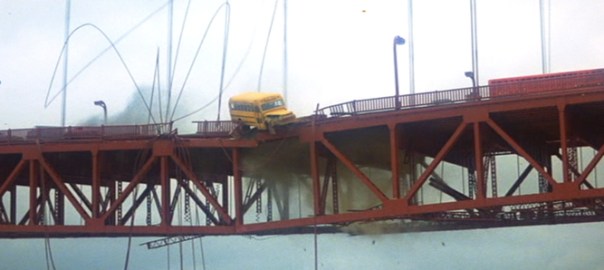
But Superman was the first comic book movie, and they hadn’t established any ground rules yet. The film has been ping-ponging from one genre to another, including psychedelic space opera, screwball comedy and James Bond villainy, and in the last ten minutes, it’s taken a strong swerve into disaster movie.

And if you watch 1970s disaster movies — The Poseidon Adventure, Earthquake, The Towering Inferno — then you know that there’s always one character who gets sacrificed, in service of the drama.

And Lois Lane is dead.

Continue reading Superman 1.98: Turn the World Around

Superman 1.94: The Shakedown

The telephone trills.

It’s mid-November 1978 in sunny Los Angeles, and all four of the Warner Brothers, seated at their identical desks, reach for their four matching telephone receivers. “Hello?” they chirp, in unison. “These are the Warner Brothers.”

“Good afternoon, Mizter Brothers,” says the voice, in an imaginary Russo-Swiss-Mexican accent. “Zis is Alexander Salkind.”

Mr. Salkind is the executive producer of Superman: The Movie and the head of a bumbling, crumbling international crime syndicate, and he’s making a transatlantic person-to-persons call to make Warner Bros. an offer that they can’t refuse.

Continue reading Superman 1.94: The Shakedown

Superman 1.87: The Other Movie About Black People

I want to check back in about the history of blockbuster movies, which I’ve been doing sporadically so I can figure out how they work. So far, I’ve talked about the first blockbuster, the 1912 Italian epic Quo Vadis, which set the bar for the kind of large-scale spectacle that audiences could expect from the high-prestige movies. We’ve also discussed the first American blockbuster, the 1915 Ku Klux Klan recruitment film The Birth of a Nation, which pioneered most of the foundational principles of narrative filmmaking, and also made the case for the continued oppression and second-class status of Black people in the United States.

And today, we’re going to look at Gone With the Wind, the flabbergastingly successful 1939 four-hour film epic about the death of the Old South, and… well, the birth of a nation, I suppose.

Continue reading Superman 1.87: The Other Movie About Black People

Superman 1.71: The Workout

“When it comes to muscles and body,” asks a random internet user on the social question-and-answer forum Quora, “Reeve’s Superman looks nothing like Cavill’s. Why didn’t Reeve train for the part?”

That question was posed in February 2017, during the production of Henry Cavill’s third Superman film, Justice League, and while the question is insulting to Reeve, you can forgive the inquisitor getting caught up in the propaganda. By that time, Cavill and his workout routines had been featured in supermarket workout-porn mags at least four times — Men’s Health in 2011, Muscle & Fitness in 2013, and Men’s Fitness in 2015 and 2016 — in an ongoing series of public-service bulletins keeping America updated on the current status of his big-ass arms.

Continue reading Superman 1.71: The Workout

Superman 1.68: Nineteen-fifteen

I’d like to get back to the history of blockbusters, because it’s going to help us understand how big movies like Superman work, and what audiences respond to. A few weeks ago in “Dawn of the Blockbuster“, I wrote about the 1913 Italian epic Quo Vadis, which was the first feature film specifically designed to amaze the audience with grandeur and spectacle. Today, I want to talk about The Birth of a Nation, the 1915 American movie which was more popular and more profitable than any other film in the first three decades of motion pictures.

The Birth of a Nation is one of the most influential films ever made, an eye-popping, jaw-dropping spectacle that invented most of what we know as the language of cinema. It’s also one of the most evil films ever made, a grotesque three-hour Ku Klux Klan recruitment film that grievously damaged race relations in America, in ways that we’re still feeling today. Sometimes movies can be several things at the same time.

Continue reading Superman 1.68: Nineteen-fifteen

Superman 1.24: A Balanced Breakfast

Martha wakes up, and remembers.

In that first moment just after dawn, her head still clearing from sleep, there’s a fraction of a second when nothing has changed.

She opens her eyes and Jonathan isn’t there, because he couldn’t sleep — worried about the taxes again — and he ended up dozing in the armchair in the living room, a magazine in his lap.

She opens her eyes and Jonathan isn’t there, because his leg is bothering him again, and he went downstairs to do those funny exercises the doctor told him to try.

She opens her eyes and Jonathan isn’t there, because

Because he isn’t there.

And Martha remembers.

There’s work to do. It’s a farm, there’s always work to do, and now there’s even more. She’ll get up, and get dressed, and she’ll make breakfast for Clark — a complete breakfast, the best way to start the day, with two eggs, a slice of buttered toast, a glass of orange juice and the delicious whole-grain oats crunch of General Mills’ Cheerios.

Continue reading Superman 1.24: A Balanced Breakfast

Superman 1.23: The Myth of the Monomyth

Around dawn, Clark wakes from a restless slumber and there’s a hum somewhere — some high, electric, pulsing hum coming from the general barn area, and it gets louder, the longer he thinks about it. Something’s out there, something that was buried a long time ago.

People should always dig up mystery boxes, it’s just good protocol. If somebody went to all the trouble to bury their secrets deep in the earth, then obviously it’s supposed to be dug up and exposed to the open air again. Nine times out of ten, something terrible happens, but you never know, you might be the lucky one.

It’s December 15th — just before Christmas, 1978 — and Clark is unwrapping his gift ten days early. Inside, he finds a little green lightsaber, which is literally the thing that every kid in America is hoping for this year.

This is the Call to Adventure, and if you’ve got your Joseph Campbell Hero with a Thousand Faces bingo card handy, you can cross that one off the list. This is the hero venturing forth from the world of common day, aka this wheat field, into a region of supernatural wonder, aka the North Pole, where he’ll get Supernatural Aid and/or Cross the First Threshold, and then go into the Belly of the Whale and set out on the Road of Trials, which I think is the Daily Planet typing test. Unless the Belly of the Whale was the space capsule, of course, in which case the Road of Trials was probably running faster than the train, and now it’s time to meet Woman as the Temptress. Which is probably Lois, but at the moment she’s only nine years old, so it might be somebody else.

Well, today’s the day that we get all this figured out. It’s time for us to ask whether Superman: The Movie follows Joseph Campbell’s model of the Hero’s Journey, as an example of the universal monomyth. The answer, obviously, is of course it fucking doesn’t.

Continue reading Superman 1.23: The Myth of the Monomyth